The approach
Fix the data before touching the model.
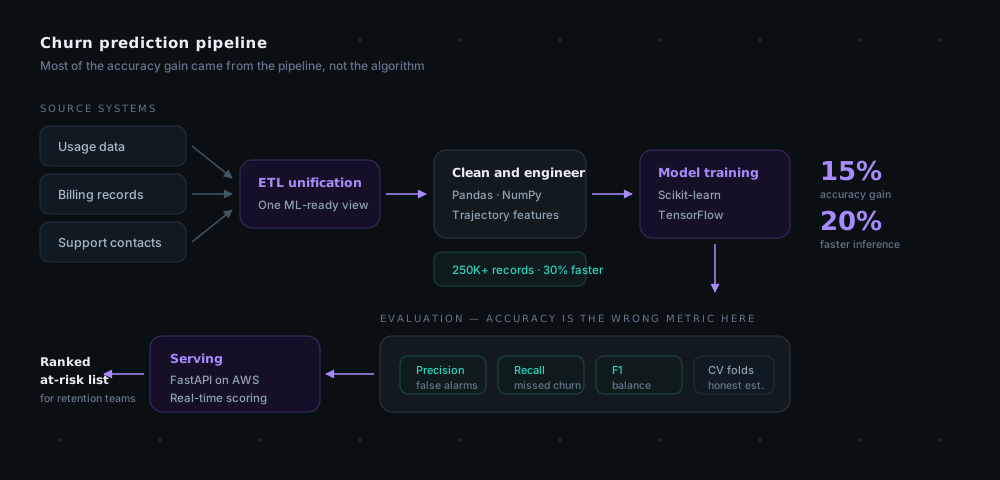
Most of the accuracy gain came from the pipeline, not the algorithm. Cleaning and unification did more work than any model swap.
01
Collection & cleaning
250K+ customer records collected, cleaned, and transformed with Pandas and NumPy — raising data quality and cutting preprocessing time 30%.
02
ETL unification
Improved ETL pipelines to integrate usage, billing, and support data from multiple enterprise systems into a single ML-ready view.
03
Feature engineering
Behavioural and billing features derived from the joined data, capturing trajectory over time rather than point-in-time snapshots.
04
Model training
Supervised classification models built with Scikit-learn and TensorFlow, improving churn prediction accuracy 15% over the prior baseline.
05
Evaluation
Cross-validation, confusion matrices, and precision / recall / F1 analysis — because on imbalanced churn data, raw accuracy hides the failure mode that matters.
06
Serving
Trained models deployed as FastAPI REST APIs on AWS, cutting inference response time 20% and enabling real-time churn scoring.