Technical support teams were answering the same questions over and over, digging through thousands of pages of manuals and SOPs to find answers that already existed. I built a Retrieval-Augmented Generation platform that finds those answers itself — and cut ticket volume by more than a third.
Product knowledge lived across technical manuals, standard operating procedures, and years of accumulated support documentation. The information was there. Retrieving the right passage, for the right question, at the right moment was the bottleneck.
Keyword search returned documents, not answers. Engineers re-derived solutions that had already been written down. Every repeated question consumed specialist time that should have gone to genuinely novel problems.
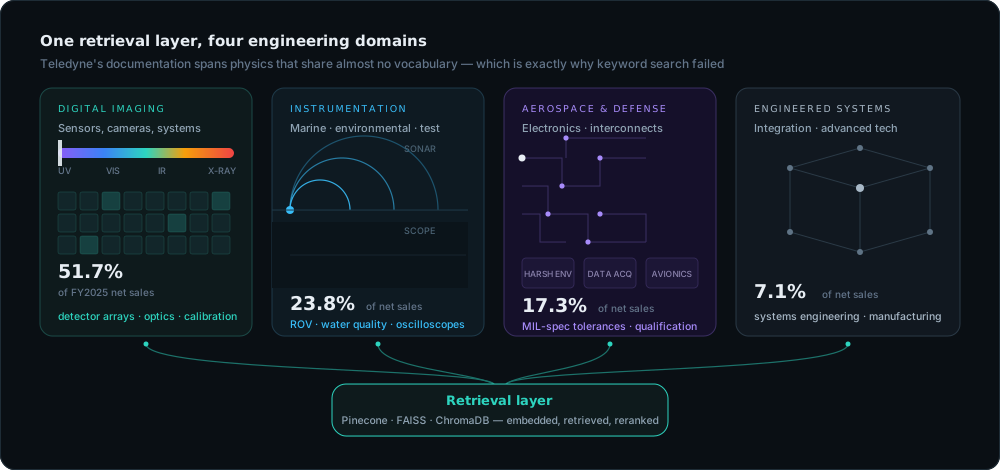
Teledyne runs four business segments, and the documentation reflects that spread — detector arrays and optics in one manual, sonar and water-quality instruments in the next, MIL-spec interconnects in a third. Those domains share almost no vocabulary. A term like "drift" means sensor calibration in imaging, signal baseline in test equipment, and vessel positioning in marine. Keyword search cannot tell them apart.
The goal was not a chatbot. It was a system that could ground its answers in the company's own documentation and be trusted in a technical context where a confidently wrong answer is worse than no answer.
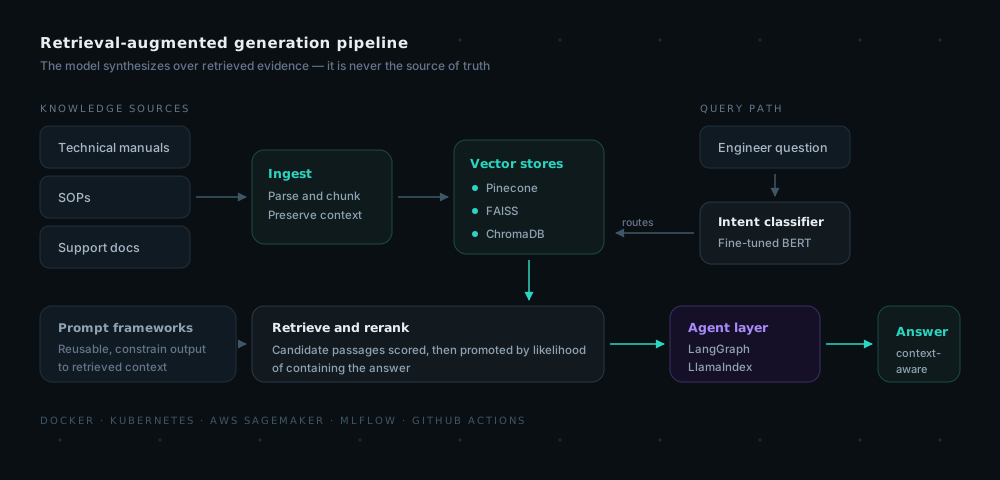
The architecture treats the language model as a synthesizer over retrieved evidence rather than a source of truth. Everything upstream of generation exists to put the right context in front of it.
Getting to production meant treating the AI services like any other piece of infrastructure. Every component was containerized with Docker and deployed as scalable inference workloads on Kubernetes and AWS SageMaker — which brought deployment time down 40% and let capacity follow demand.
Training, deployment, and version management run through GitHub Actions and CI/CD, with MLflow handling experiment tracking and model registry. Continuous monitoring watches for data drift and triggers proactive retraining rather than waiting for quality complaints.
Alongside the engineering, I worked with product teams and domain experts to fold these capabilities into existing enterprise applications, and mentored junior engineers through code review and technical guidance.
Support ticket volume fell 35% as the platform absorbed the recurring questions. Semantic search relevance improved 30% with lower retrieval latency, and fine-tuned intent classification lifted response accuracy 18%.
The broader result is structural: knowledge that used to depend on whoever happened to remember it is now retrievable by anyone who asks — and the pipeline keeps improving as new documentation lands.